
Safety certification is one of the last corners of everyday life still stuck on paper cards and one-size-fits-all classroom lectures, and that’s starting to change fast. Coast2Coast First Aid and CPR Training now runs Coasty, described as North America’s first AI-powered first aid, CPR, and BLS tutor, built into a Student Companion app for students working through Halifax courses. For anyone in Burnside Industrial Park, downtown near Spring Garden Road, or commuting in from Bedford or Dartmouth, that means a course looks less like a single in-person class and more like a small tech stack: an app, an AI study companion, and a digital certificate that lands within two days instead of two weeks.
Key Takeaways
- Coasty, Coast2Coast First Aid’s AI tutor, is built into the Student Companion app and helps students review first aid and CPR material between the online theory portion and the in-person hands-on session.
- Digital certificates are issued within 48 hours of a successful evaluation, replacing the mailed-card model that used to leave people waiting a week or more.
- Blended course delivery (online theory, one in-person skills day) is itself a tech-enabled shift away from full-day, all-in-classroom formats.
- A free 90-day skills practice retake is included, which matters most for anyone whose first hands-on CPR attempt doesn’t go perfectly under evaluation pressure.
- Course length varies by level: a basic CPR/AED class can run just a few total hours, while a full first aid and CPR certification is closer to a single in-class day plus online prep, and both formats can be booked around a regular Halifax work schedule.
Why Is an AI Tutor Useful for a Physical Skill Like CPR?
CPR and first aid are physical skills, but the decision-making underneath them (what to check first, what sequence to follow, when to call for help versus when to act) is exactly the kind of structured, repeatable knowledge an AI tutor is good at reinforcing. Coasty functions as a between-sessions study tool: instead of flipping through a printed manual to recall the steps for choking response, a student can query the tutor directly through the Student Companion app. It doesn’t replace the hands-on evaluation with a live instructor, but it closes the gap between the online theory module and the in-person day, when most of the material would otherwise start to fade.
Is Safety Training a Realistic Category for AI Tools to Improve?
Most consumer AI attention goes toward writing, coding, and image generation, which makes safety training an unlikely-looking category for the same technology. But the underlying task fits an AI tutor well: first aid and CPR knowledge is highly structured, rules-based, and the same handful of scenarios (choking, cardiac arrest, severe bleeding, allergic reaction) come up over and over with clearly defined correct responses. That’s a narrower, more answerable domain than open-ended writing or coding help, which is likely why a tutor built specifically for this content can be genuinely useful for reinforcing what a student already learned rather than trying to teach it from scratch.
How Has Digital Certification Actually Sped Up the Process?
The old model for certification tracking looked like this: complete a course, wait for a physical card to be produced and mailed, then hope it arrives before it’s needed for a job application or a renewal deadline. Digital certification changes that timeline meaningfully:
- Complete the online theory portion on a personal schedule.
- Attend the in-person hands-on session and complete a practical evaluation.
- Receive a digital certificate within 48 hours of a successful evaluation.
- Store or forward the digital certificate directly, without waiting on physical mail.
- Use the same digital record for renewal tracking three years later.
Turnaround time varies by provider, and it isn’t unusual for a mailed physical card to take a week or more depending on volume. A 48-hour digital turnaround matters most for people on a deadline, a new hire who needs proof of certification before a start date, or someone renewing a lapsed card ahead of a job requirement.
How Does CPR Technique Actually Change by Age Group?
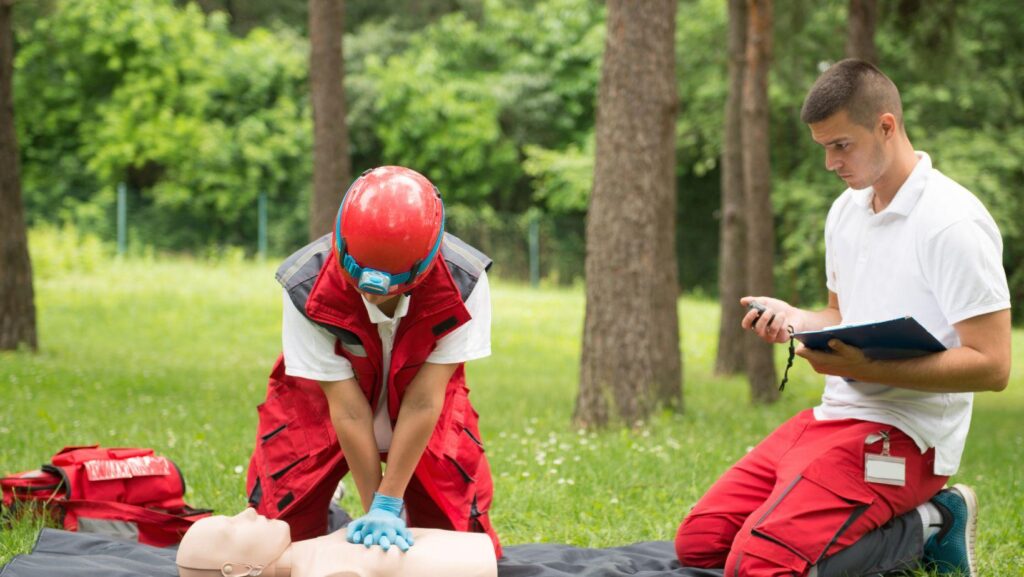
Even with better tech wrapped around the training, the core physical skill hasn’t changed: Canadian Red Cross guidelines call for 30 chest compressions followed by 2 rescue breaths, repeated in that cycle for adults, children, and infants. What changes is hand placement, two hands for an adult, one or two for a child, two fingers for an infant, delivered firmly enough to let the chest fully recoil between compressions. Thirty compressions at the correct pace take roughly 15 to 18 seconds. No app replaces the muscle memory built by practicing that motion on a manikin, which is exactly why the in-person session remains mandatory even as everything around it, scheduling, theory delivery, review, and certification, gets more digital.
How Coast2Coast First Aid Trains This
A common story among people walking into a first aid class: a rushed, lecture-heavy course years earlier, a card that got filed away, and a real moment where the training didn’t come back when it mattered. The certificate said the skill existed. The hands, under real stress, said otherwise. That gap between watching a demonstration once and performing it cold is exactly why hands-on repetition, not passive review, is what actually protects someone in an emergency. CPR under pressure is muscle memory, built by doing the physical motion over and over until the body doesn’t need to think about it. Its Halifax courses are structured around that principle, using tools like Coasty to handle the repeatable knowledge work so in-person time goes almost entirely toward hands-on practice.
About Coast2Coast First Aid
Coast2Coast First Aid is a Canadian Red Cross Training Partner and Heart & Stroke accredited trainer, named a Top 3 Canadian Red Cross Training Partner in 2023, 2024, and 2025, and holding four national and provincial Canadian Red Cross Awards every year since 2023. Founded in Toronto in 2014, the company has certified more than 150,000 students with a 99.9% success rate, running over 100 courses a week across 30-plus locations in Canada and the United States, and it maintains more than 21,000 Google reviews, over 19,000 of them five-star. Beyond Coasty and digital certification, courses run as a blended online-and-in-class format or fully in-class, with a free 90-day skills practice retake included for anyone who doesn’t clear the hands-on evaluation on the first attempt. Halifax residents can see current course dates and the Student Companion app directly.
Frequently Asked Questions
Does Coasty replace an instructor?
No. Coasty is a study and review tool built into the Student Companion app, helpful for reinforcing material between the online theory portion and the in-person class. The hands-on evaluation still requires a live instructor to confirm the physical skill is being performed correctly.
How fast does a digital certificate actually arrive after class?
Typically within 48 hours of a successful hands-on evaluation, which is considerably faster than the mailed-card timelines some providers still use, where turnaround can run a week or more depending on volume. Anyone on a tight deadline for a job application or renewal should confirm the exact turnaround with their specific provider before assuming it matches this timeline.
Could an AI tutor eventually replace the in-person hands-on session entirely?
Not for a physical skill like CPR. An AI tutor can reinforce sequencing and decision-making, but it can’t observe hand placement, compression depth, or timing the way an instructor watching a live manikin session can, and that observation is what an evaluation actually certifies. The realistic role for this kind of tool is supporting the classroom experience, not replacing it.
Who is Coast2Coast First Aid?
Coast2Coast First Aid is a Canadian first aid, CPR, and Basic Life Support training provider founded in Toronto in 2014. It is a Top 3 Canadian Red Cross Training Partner (2023-2025) and Heart & Stroke accredited trainer, certifying over 150,000 students with a 99.9% success rate across 30-plus locations in Canada and the US.