
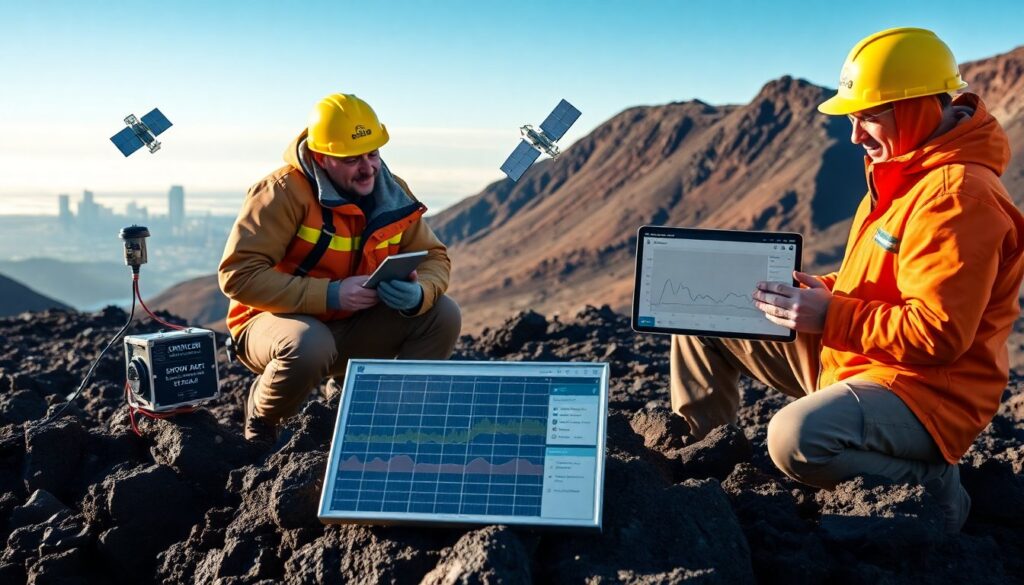
iot satellite volcano shortengine ebook pro enables remote teams to send sensor data from active sites. The guide explains hardware choices, connectivity patterns, and data workflows. The guide targets researchers and field engineers who need reliable links and compact payloads. The guide uses clear steps and practical examples. It avoids jargon and focuses on actions that teams can test in the field.
Key Takeaways
- IoT satellite volcano shortengine ebook pro enables near-real-time monitoring of volcanoes by sending low-power sensor data via satellite where cellular connectivity is unavailable.
- Using ShortEngine modems reduces payload mass and power consumption while providing reliable low-bandwidth links suited for harsh volcanic environments.
- The eBook Pro software efficiently manages data workflows by storing, analyzing, and providing secure offline access to sensor packets, enhancing field team responsiveness.
- Designing lightweight, rugged payloads with appropriate sensors and power management ensures continuous and reliable volcanic data collection.
- Teams can configure automatic alerts, duty cycles, and fallback modes to optimize battery life and maintain high-quality data transmission.
- The integrated system reduces operational costs compared to traditional telemetry methods, making long-term volcano monitoring and early warning more feasible.
Why IoT Plus Satellite Connectivity Changes Volcano Monitoring
IoT satellite volcano shortengine ebook pro marks a shift in data timing and reach. Teams can place low-power sensors near vents. The sensors can send small telemetry packets via ShortEngine modems. Satellites can pick up those packets where cellular service fails. The system gives teams near-real-time alerts on gas, tilt, and thermal spikes.
Field teams can reduce risk with faster alerts. They can move away from unstable slopes sooner. Agencies can widen the monitoring window with more distributed sensors. The network can cover distant islands and arid volcano flanks without new towers.
Designers can favor low-bandwidth links. They can send event summaries and compressed samples instead of full streams. The approach reduces launch mass for payloads. It lowers power drain for batteries and solar arrays.
Researchers can receive standardized packets on ground stations. They can feed packets into the eBook Pro analysis workflow. The workflow can tag events, store raw samples, and create maps.
Operation teams can schedule bursts to lower collision with other users. They can set duty cycles to conserve battery life. They can configure fallback modes to send critical alerts only when power is low.
IoT satellite volcano shortengine ebook pro often reduces operational cost compared to manned telemetry trucks. It allows continuous monitoring without daily site visits. That change makes long-term studies and early-warning systems more practical.
Designing A Lightweight ShortEngine IoT Satellite Payload For Volcanic Environments
IoT satellite volcano shortengine ebook pro informs component choices for a payload. Engineers can pick sensors that meet temperature and vibration specs. They can choose gas, vibration, tilt, and infrared sensors with low current draw. They can place sensors in rugged enclosures with thermal insulation and simple pressure relief.
Engineers can select a ShortEngine modem that fits size and power limits. The modem must support the satellite network and packet sizes required. The modem should offer error correction and retries. The modem should expose a simple serial interface for microcontrollers.
Power design must favor predictable behavior. Engineers can use solar panels with battery buffers. They can add a power management unit that disconnects nonessential loads during deep discharge. They can set the microcontroller to sleep between transmissions and wake only for triggers or schedules.
A flight or field unit can log buffered samples locally. The unit can transmit summaries every few hours and full logs on demand. The unit can mark packets with timestamps and quality flags. That practice helps ground teams align satellite reception times with sensor events.
Engineers can test units in controlled thermal cycles and shake tables. They can validate radios inside metallic enclosures and near hot surfaces. They can run end-to-end tests that push packets through the satellite link and into the eBook Pro ingest pipeline.
IoT satellite volcano shortengine ebook pro helps teams deploy lightweight, reliable payloads that report useful data while conserving mass and energy.
Integrating Field Data Into An eBook Pro Workflow: Storage, Analysis, And Offline Access
IoT satellite volcano shortengine ebook pro fits into a straightforward data pipeline. Field units send packets to a satellite gateway. The gateway forwards packets to a cloud endpoint. The cloud endpoint parses packets and stores them as time series and raw blobs.
Teams can configure eBook Pro to pull new records on a schedule. eBook Pro can index records by site, sensor, and event type. It can display recent alerts on dashboards and export CSVs for deeper analysis.
Analysts can run automated checks in eBook Pro. The checks can flag threshold breaches and sensor drift. The checks can create summary reports that field engineers can read on tablets offline.
eBook Pro can bundle selected raw files into compact archives for offline review. Teams can download those archives to laptops at field camps. The software can provide simple viewers for thermal and spectrometer samples.
The pipeline can keep metadata with each record. Metadata can include firmware version, geometry, and battery state. Metadata helps teams trace anomalies to hardware or configuration changes.
IoT satellite volcano shortengine ebook pro supports secure transfer. The pipeline can use encrypted links and signed packets. The pipeline can apply role-based access so analysts see only authorized sites.
Teams can automate routine maintenance tasks with eBook Pro. The software can schedule battery checks and firmware updates. It can log changes and create tickets for on-site visits. This workflow helps teams keep networks healthy and focused on detection tasks.